Tweak a part you've got.Or invent one from an idea.
Describe it like you'd explain it to a friend who happens to be an engineer, or hand Tweak a model and say what's wrong with it. He sketches it, measures it, checks it.
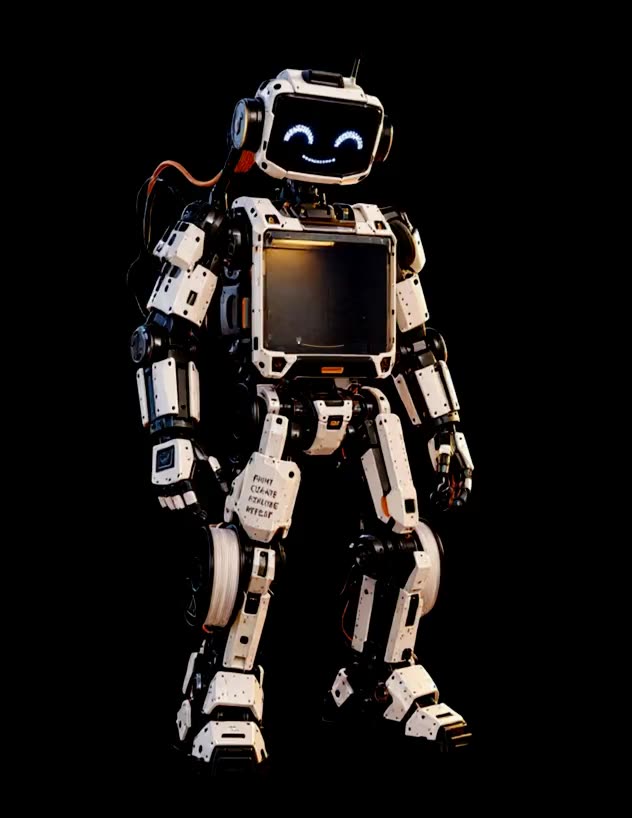
Send me a photo. I'll tell you exactly what to measure.
Talk it through. He'll get the sizes right.
Tell him, or show him
A description, a photo, or your own STL, 3MF or STEP.
He sketches the options
Two or three ways to make it, with his pick.
- Simple hook that drops over the front edgeHis pick

- No drilling or marks on the desk
- Can slide sideways or rattle under a sharp tug
- Clamp that squeezes the desk edge with a thumbscrew

- No drilling or glue, works on almost any edge thickness
- Sticks out further below the desk than the other options
- Small bracket screwed into the underside

- Very strong, holds still with no wobble
- Puts two permanent screw holes in the desk
He tells you what to measure
A diagram for every distance that decides the fit.
How thick is the desktop where the hook will sit, in mm?

How much open space is there below the desktop before anything else is in the way (a rail, a drawer), in mm?

You see the price, then he builds it
Nothing is built until you approve the price.
Real concepts from the chat for: “a hook to hang my headphones under my desk”
Got a model that's nearly right? Send it over.
Already got a model? He'll change it.
Upload an STL, 3MF or STEP and say what's wrong with it.
“make this jar unmistakably shaped like a dog's paw print seen from above, but keep the threaded neck exactly the same so my existing lid still fits”
↔ drag to turn · tap for 3D
“make this a triple hook instead of a double, same door thickness”
↔ drag to turn · tap for 3D
“add the word BITS in big raised letters across the top of this lid”
↔ drag to turn · tap for 3D
Tap the part you want changed.
Upload a 3MF or STL. He measures it, shows it in 3D, and you tap the part and say what should change. He aims his options at that part.
This box is a drawing. STEP files skip the 3D view: just say what to change.
A finished design stays open.
Printed it and the lid is tight? Pick that part, say what to change, and you get a new version. Not feeling it at all? Ask for different ideas and choose again. You see the price before anything is charged.
- v1First build
- v2Changed the Lid: 5 mm taller
- v3Changed the Latch: looser fit
Put one of our drawings on it.
Upload a model and ask for one of these (“make the lid look like a cat”). When a flat face fits it, he offers it there, raised or engraved. You see where it goes before you approve.








Common parts, ready in seconds.
Ask for one of these and he skips the design round. Set the sizes, approve, and it is built from our own tested part, usually in under a minute.
Not just shapes. Things that turn, screw and snap.
Three-gear spinner · 3:1 hand-cranked gear pair · Screw-top jar · Wall spool holder · Rack and pinion slider
“three meshing spur gears on pegs on a hand-held plate, 30, 20 and 15 teeth, module 2, so turning one turns the others”
Three-gear spinner
4 parts · 3.3 h print · 83 g
“a 3:1 spur gear pair on 8 mm shafts in a small frame, with a hand crank on the driving gear”
3:1 hand-cranked gear pair
4 parts · 3.8 h print · 58 g
“a small screw-top jar for screws and drill bits, 50 mm across and 60 mm tall, with a threaded lid”
Screw-top jar
2 parts · 1.4 h print · 37 g
“a wall-mounted filament spool holder with a 52 mm spinning axle that snaps into the bracket”
Wall spool holder
2 parts · 3 h print · 84 g
“a rack and pinion slider: a 120 mm rack that slides in a guide channel, driven by a pinion with a thumb wheel”
Rack and pinion slider
4 parts · 2.4 h print · 44 g
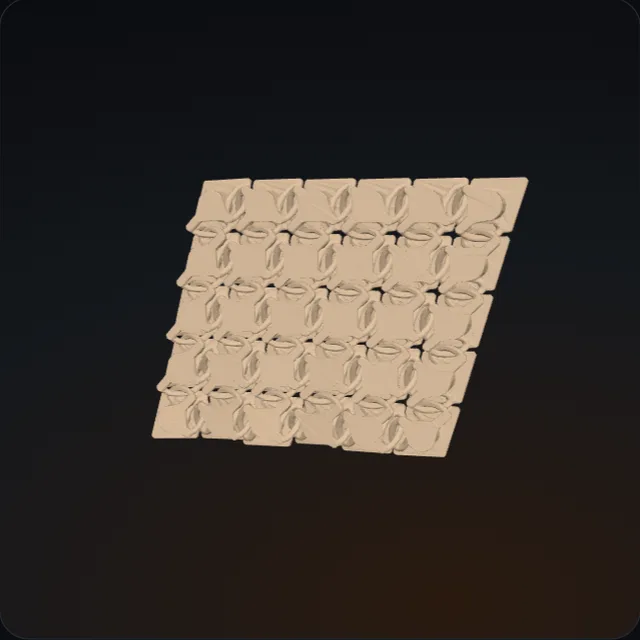
Fabric you can print.
Ask for a shape and he fills it with small linked tiles. It prints flat in one go, with no supports, and bends like cloth once it's off the bed.
If it fails one, I fix it before you see it.
He works from an engineering playbook.
37 rules for gears, hinges, snap-fits, springs, bearings and print-in-place parts, corrected against real prints, plus the rules every FDM part needs. Then five checks on every part:
- Solid and watertight: no holes, no paper-thin walls.
- Fits and clearances: measured gaps where parts slide, turn or press together.
- Gears mesh: centre distance checked, then both gears turned through a full sweep to prove they don't bind.
- Clips and arms are strong enough: the bend is worked out against PLA and PETG limits.
- Sliced on a real slicer and priced: the print time and grams are real, and you see the price before you pay.
NEW
- Parts that need supports come with support fins you can download and print separately.
- Strength is worked out from the direction the part prints, and supports are measured, not guessed.
- Ring gears and racks are checked too, not only plain gears.
- If the approach you picked won't work, he asks before changing it.
First one's on me.
You see the price before he builds.
Free
when it's quoted at £3 or lessEach build after£2–4
a typical part; the exact price is shown firstMost valuePremium£9.99/mo
£12 of builds every month
priority queuePrinted and postedfrom £19
coming soon · PLA, UK onlyFailed builds are refunded automatically.
Questions
Do I need to know CAD?
No. Describe the part in plain English, with sizes if you have them. Tweak asks about anything he needs, like a hole size or what it has to fit, before he builds.
Can I change a model I already have?
Yes. Upload an STL, 3MF or STEP (up to 25 MB) and say what to change: longer, a new hole, a different fit. You need to own the model or have the creator's permission.
Can I start from a photo?
Yes. Add a JPG, PNG or WebP (up to 10 MB) of the broken part or the spot it goes, and give him the key measurements.
What do I get?
A 3MF for each part, ready to open in your slicer. Parts designed from scratch also come with a STEP you can edit in any CAD program; a reworked mesh (like an uploaded STL) and fabric come as a 3MF only. Where he can, parts that need supports come with support fins as a separate file.
Can it make fabric?
Yes, flat fabric items in a shape: a round or square coaster, a bookmark, a heart or a patch. Pick a pattern of small linked tiles (hexagon, rhombus, square, or triangles and squares) and they print flat in one go, with no supports, and bend like cloth. One colour for now.
How much does it cost?
Designing is free: 10 rounds of questions a month, where starting a design or changing its brief uses one. Your first build is free if it's quoted at £3 or less. After that you see the price before he builds, usually £2–4 for a simple part. Failed builds are refunded automatically.
How long does a build take?
Usually 3 to 30 minutes, depending on how many parts and moving pieces there are.
Can I ask for changes after it's built?
Yes. Tell him what to change in the same chat, and each design includes 3 changes.
What won't he make?
Weapons or weapon parts, trademarked characters or logos, and anything unsafe. Don't use a part anywhere its failure could hurt someone.
I don't have a printer. Can you print it?
Not yet. Printing in PLA and posting it (UK only, from £19) is coming soon. For now you get the files, to print yourself or take to a local print service.
Can I sell prints of my part?
Yes. The files are yours to print and to sell prints of. You can't resell the design files as your own design service.
Go on. What's broken?